A Mixed Reality Interface for Safer Pedestrian Crossings
A speculative interface for the future that guides attention from the phone back to the road
- Role
- Concept, research and prototype
- Course
- Future Interfaces, UCL MSc HCI
- Built with
- Unity, Meta Quest 3S
- Year
- 2026
Overview
Walking while using a mobile phone is normal in everyday life, but it can make road crossings more dangerous. This is a speculative mixed reality interface for the future that supports pedestrians visually absorbed in their phones when approaching a crossing.
Rather than issuing a loud warning, the interface gently reduces the visual prominence of phone content and introduces a spatial cue directing attention toward the road. The design is grounded in research on phone distraction, augmented reality, and diminished reality.
The problem
One of the most common risks in walking remains simple: people often keep looking at their phones when they should be watching the road. At pedestrian crossings, a short delay in noticing traffic can have serious consequences.
Texting is linked to significantly fewer left and right checks and increased near misses with vehicles. UK contributory factor data does not yet capture pedestrian phone use, but the behavioural evidence makes the risk clear.
17%
rise in people killed or seriously injured in crashes linked to phone use, in the decade to 2022
Reported Road Casualties Great Britain, 2022
12 to 45%
of pedestrians are distracted while crossing, with texting linked to fewer left and right checks
Simmons et al., 2020
15×
growth in smart glasses shipped a year, from under 3 million in 2024 to around 45 million by 2035
Counterpoint Research
A different paradigm
Unlike conventional safety systems that rely on alerts, this design introduces perceptual rebalancing. Rather than adding more information, the system selectively reduces the visual dominance of distracting content while enhancing task relevant environmental cues.
This shift from information delivery to attention guidance is the contribution: safety not as an interruption, but as adaptive modulation of perception.
What the research says
Mobile technology use impairs road crossing decisions and increases crash risk (Schwebel et al., 2016). The strongest risks arise when distraction is visual and manual, such as reading or typing (Jiang et al., 2018), and visual distractions cause greater impairment than cognitive ones such as listening to music (Yadav and Velaga, 2022). The problem is not the presence of the phone but the way it absorbs attention.
Existing interventions are insufficient (Larue et al., 2023), and no single one is fully effective without an integrated approach (Osborne et al., 2020). If a user is already absorbed, an extra notification may be missed or simply join the visual clutter.
AR overlays can improve perceived safety at crossings (SafeARCross, 2024), but have also been linked to higher workload (Malik et al., 2025). Diminished reality can support selective attention and reduce workload (McLaughlin et al., 2025), and visually camouflaging a smartphone made most participants report it as nearly or completely invisible (DiminishAR, 2025).
Together, the literature points toward a direction that is both simple and novel: reduce the salience of the phone and gently raise the salience of the road.
Vision for the future
As ambient computing moves from the hand to the face, the pedestrian remains the least instrumented and most distractible actor in an otherwise automating mobility system. The Department for Transport projects roughly 40 percent of cars will have self driving capabilities by 2035.
The interface targets people in cities who walk while checking messages, maps or social media, in the brief moment between walking and crossing. It assumes mixed reality glasses combining location awareness, computer vision and gaze tracking, and it is deliberately not a warning system. It does not flash, speak loudly, or demand immediate action. It treats attention as something to be guided rather than commanded.
Diverging: four directions
The process followed the Double Diamond. How can technology support a distracted pedestrian without adding another interruption? Several directions were explored before converging. They highlighted a central trade off: strong interventions risk rejection, while weak ones risk being ignored.
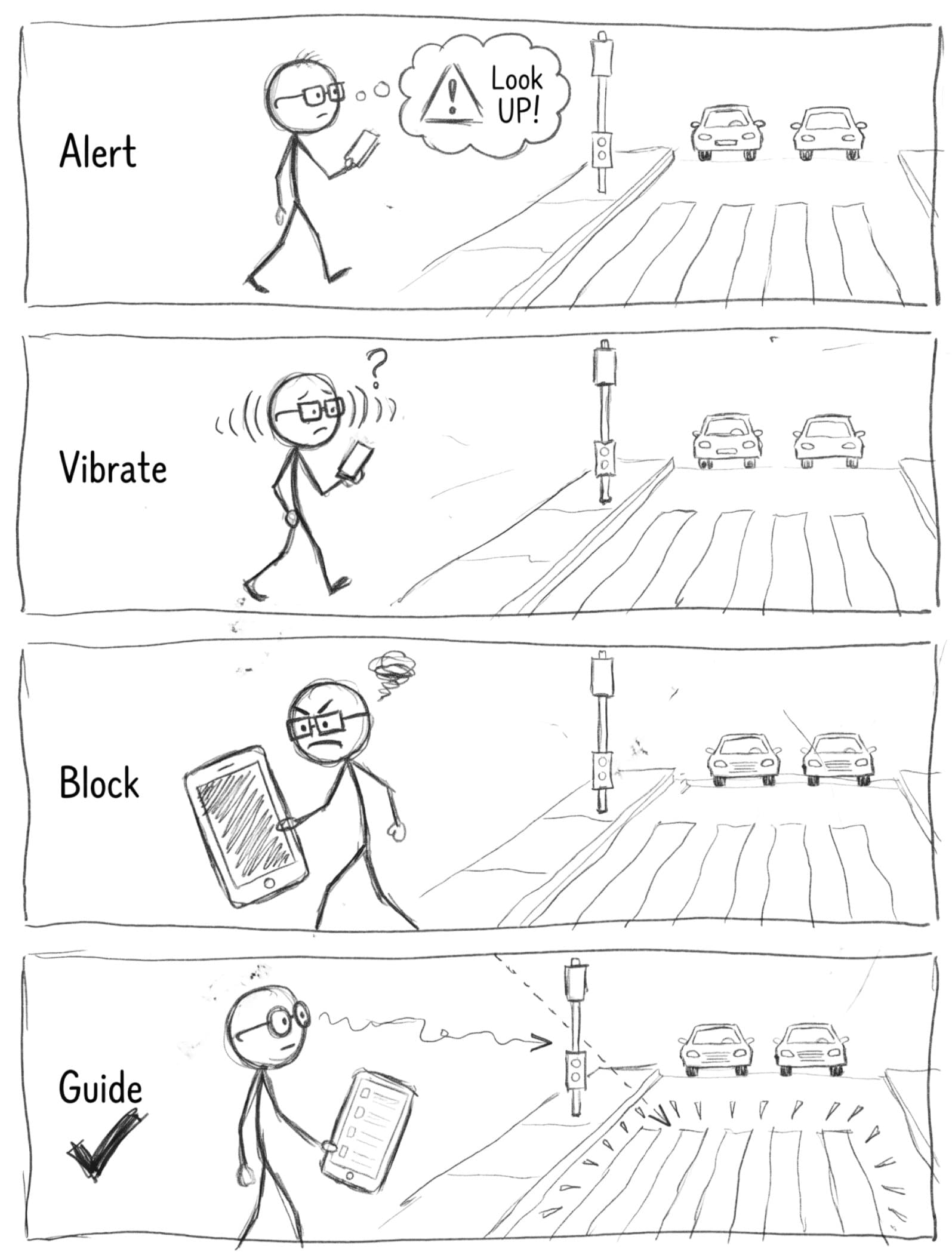
Alert
Auditory alerts or visual pop ups. Cognitively absorbed users may habituate to alerts, and such warnings risk notification fatigue and social disruption in public.
Vibrate
Haptic feedback near a crossing. Less visually intrusive, but haptic signals lack spatial specificity and cannot communicate where attention should go.
Block
Temporary content lockout, fully obscuring the phone near crossings. Effective at forcing attention, but overly controlling and likely to raise objections around autonomy.
Guide
Perceptual rebalancing: subtly reduce the phone's salience while enhancing environmental cues, guiding attention rather than interrupting it.
Converging: detection
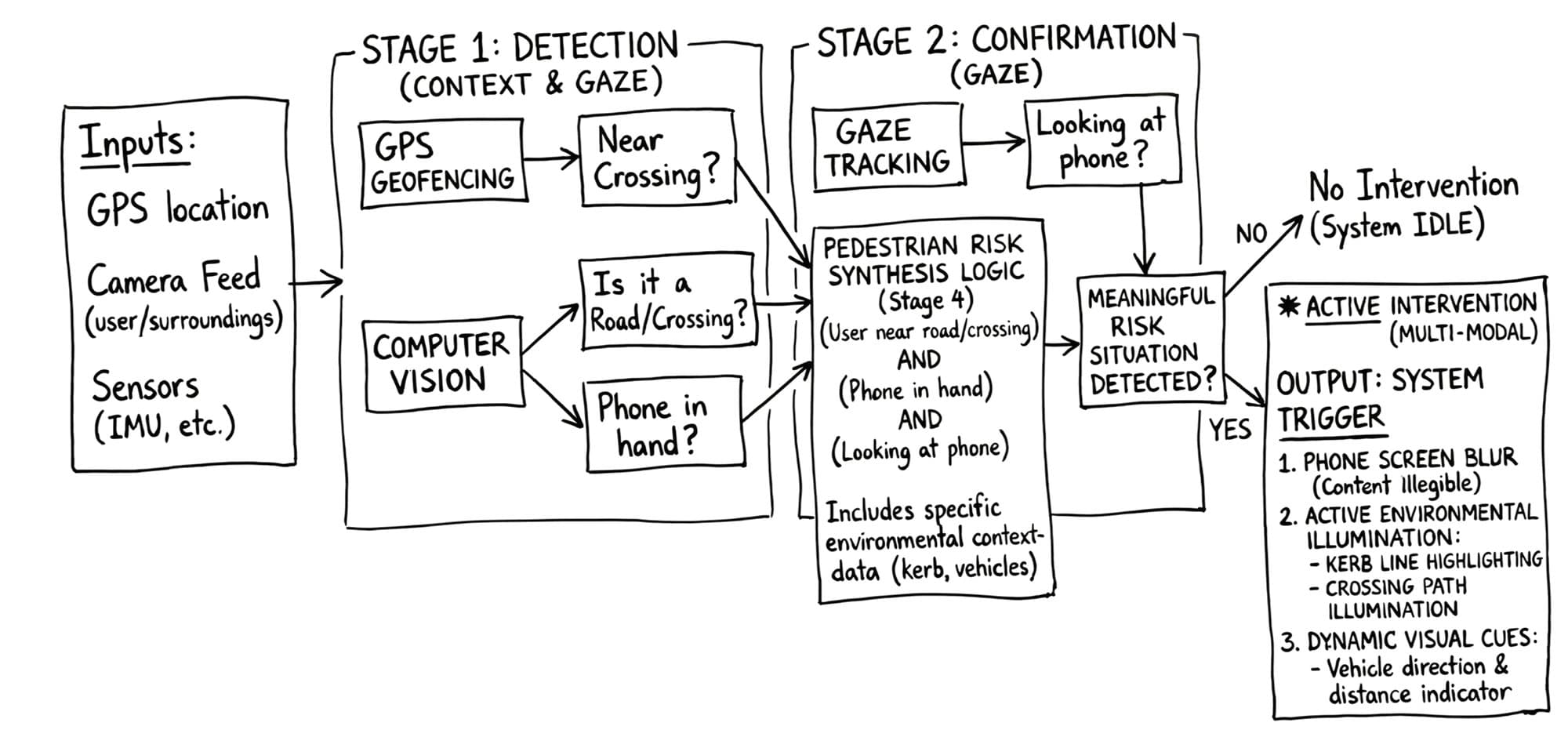
A four stage pipeline combines GPS geofencing and computer vision to recognise the crossing, then gaze tracking to confirm the user is looking at the phone rather than the road.
This two condition design avoids triggering simply because someone is near a road or holding a phone. It detects a more meaningful risk situation and reduces false positives.
Converging: how much to dim
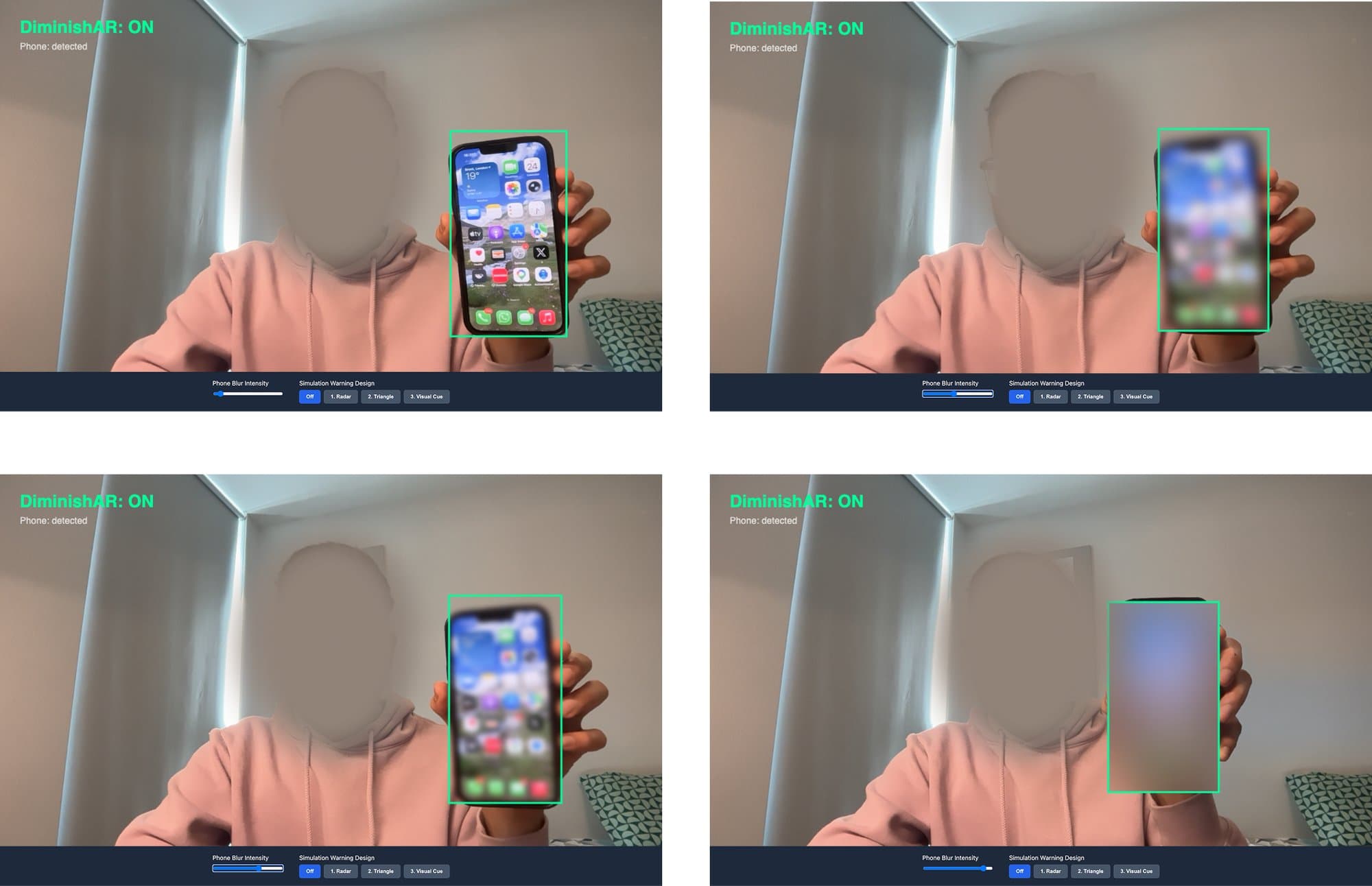
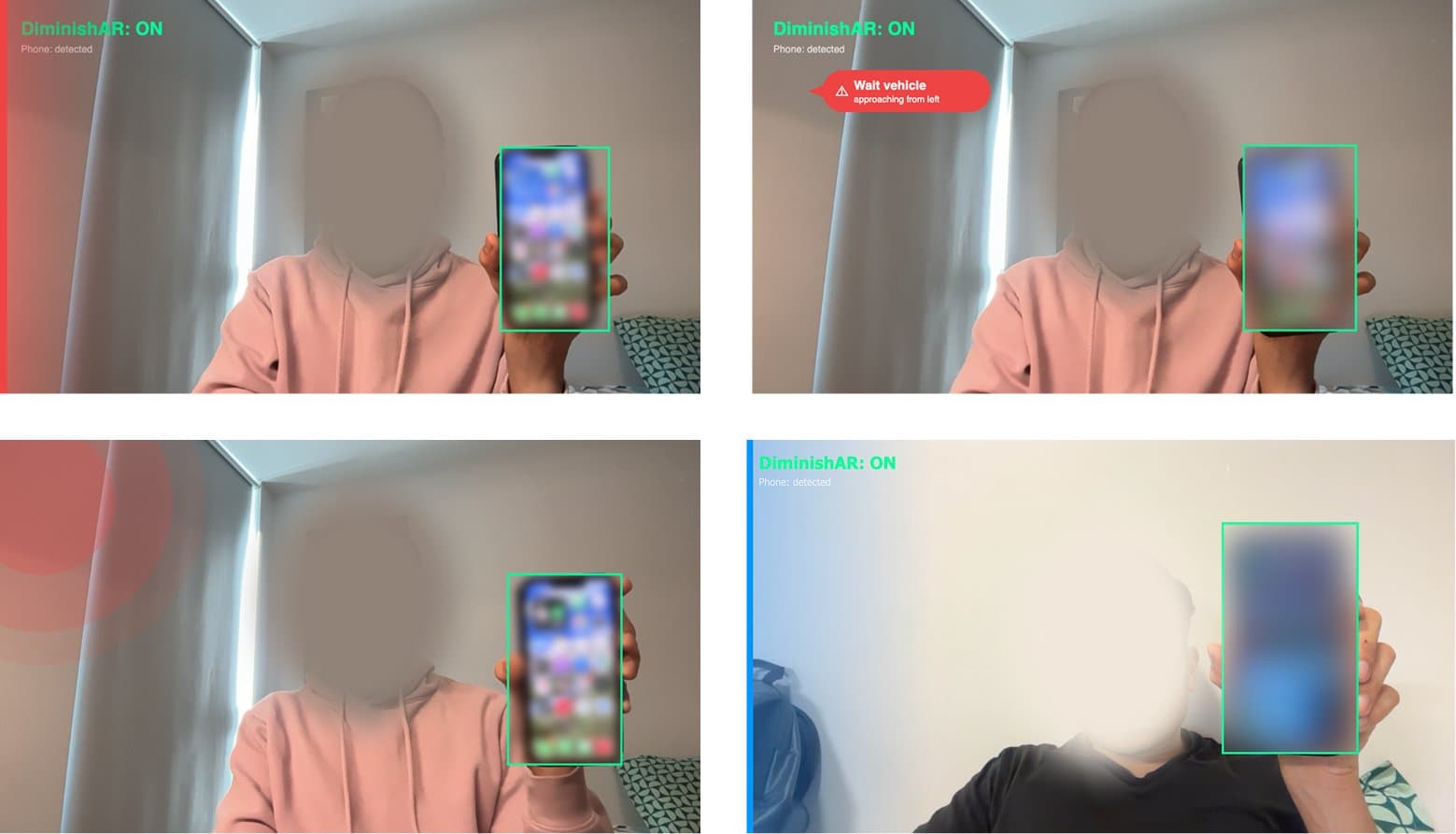
The intervention was refined in an MR simulator with an interactive blur slider, adjusting the phone overlay in real time from inside the headset. The right blur level had to be felt from the user’s perspective rather than judged from sketches.
Too little reduction left the phone visually dominant; too much felt punitive and disorienting. The final level was set where the phone became sufficiently less attractive without feeling forcibly removed.
Converging: the cue
Different warning styles were tested in the simulator, varying colour, size, intensity and animation, to find a form that felt directional rather than alarming. A floating HUD style notification was rejected for feeling disconnected from the physical environment.
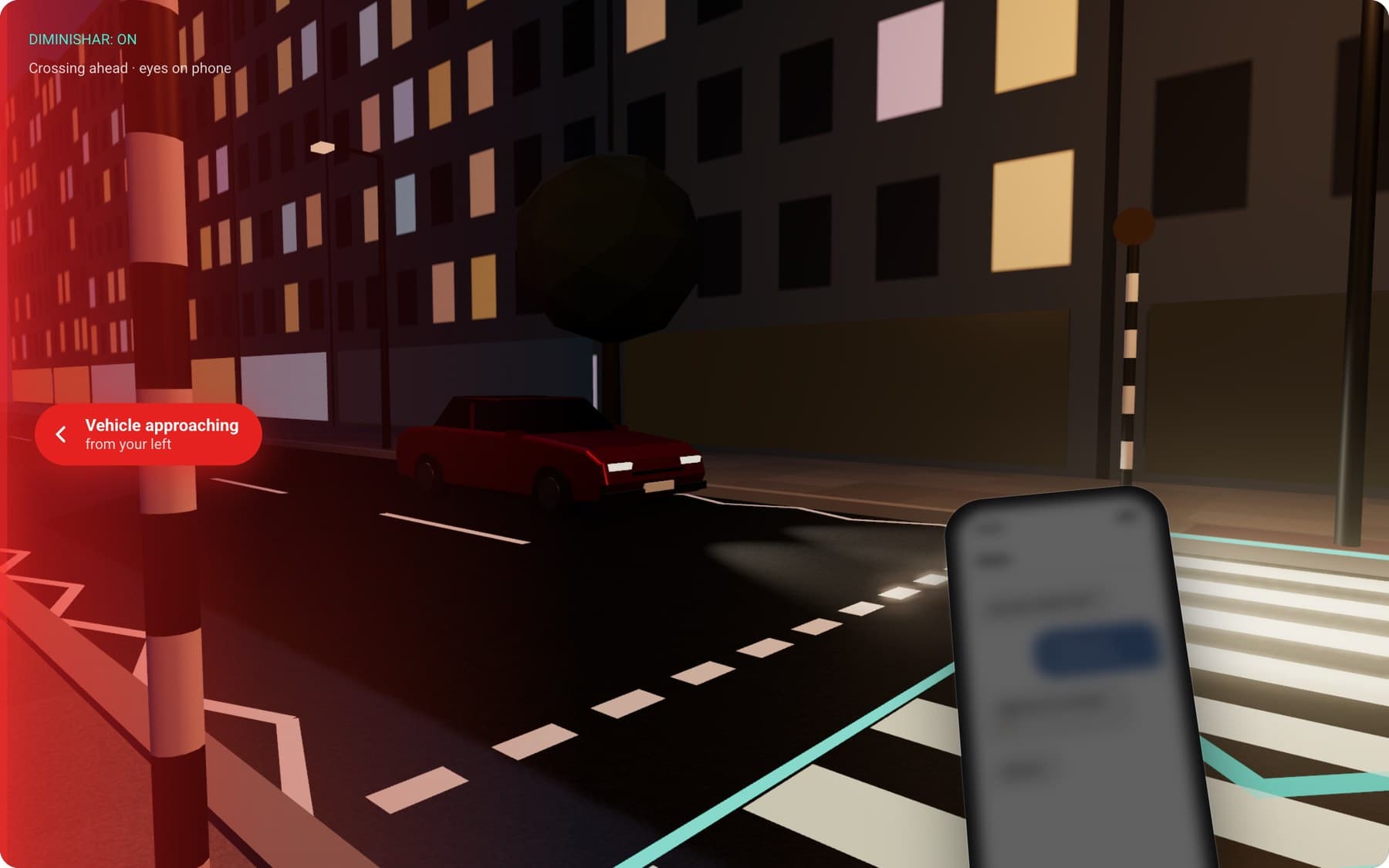
The final design is a teal line anchored to the actual kerb rather than the screen, with a perspective arrow on the road reinforcing the crossing path. Both are calm in colour and scale, deliberately avoiding the visual language of emergency.
Scenario of use
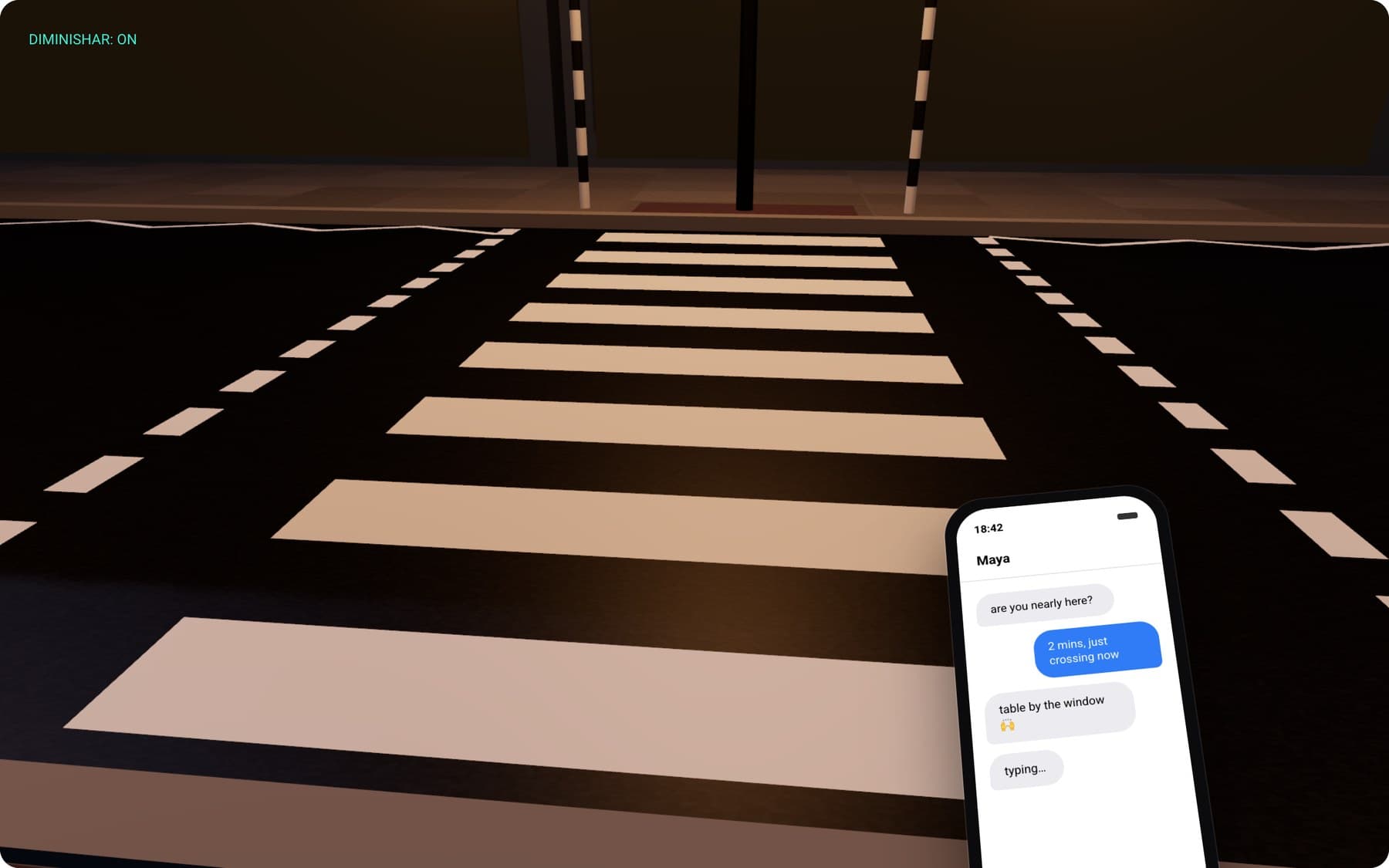
A person walks toward a crossing while reading a message or directions. The system recognises the crossing and notices their gaze stays on the phone. Instead of sounding an alarm, it dims the display and reveals a subtle cue marking the crossing zone.
As the road becomes more visually prominent, the pedestrian is drawn to look up. No manual action or response to a command is required. The system simply makes it easier to notice the road at the right moment, especially when someone may not realise how absorbed they have become.
Why glasses, and not the phone?
A fair challenge to this design: if the goal is simply to get people to look up before crossing, a phone could do part of the job. It could blur messages near a crossing, or show a prompt to look up. So why mixed reality glasses?
The phone can only change itself. It can make its own screen less interesting, but it cannot add anything to the road. Perceptual rebalancing has two halves: lower the phone, and raise the kerb, the crossing and the approaching car, anchored where they actually are. Only the glasses can do the second half. They also see what the wearer sees, so they can tell a crossing from an ordinary pavement, and sustained attention on the phone from a quick glance.
That is still an argument, not evidence. A phone only mode might deliver most of the benefit at a fraction of the cost, on hardware people already own. So rather than assume the glasses win, the evaluation compares them with a simpler phone blurring or alert based design.
How I’d evaluate it
Phase 1 uses the simulator to fix the parameters: participants try different dimming levels and kerb cue styles, rating comfort, clarity and intrusiveness.
Phase 2 deploys the refined design on a Meta Quest 3S in a within subjects study of 20 to 24 participants, on physical crossing tasks under three conditions: no intervention, a phone only condition that blurs messages or prompts the user to look up, and MR rebalancing. The phone only condition is there to answer the question above directly. Measures include gaze redirection speed, time to crossing decision, hazard detection timing and real time eye tracking, alongside whether dimming felt supportive or controlling.
H1
Participants redirect gaze toward the road more quickly.
H2
Participants detect approaching hazards earlier.
H3
Participants report lower perceived intrusiveness than with traditional alert based systems.
H4
Rebalancing in MR beats a phone only blur or look up prompt on gaze redirection and hazard detection, without feeling more intrusive.
Limits and ethics
The system depends on accurate detection of crossing proximity and sustained gaze, and errors could cause unnecessary or missed activations. Pedestrians who come to rely on it may cross less carefully when it is unavailable. Bright sunlight, crowds and reflective surfaces could interfere with the overlay, so outdoor testing would be needed.
The ethical concerns are substantial. Inferring attention means continuous behavioural monitoring in public, and changing what someone sees without per trigger consent raises questions about transparency and control. There is a consent paradox: the interface is most useful when the user is least aware of their surroundings, which is also when they are least able to judge what it is doing to their perception.
Any real implementation would need clear opt in, visible feedback when it is active, local processing, and user control over sensitivity. People also respond differently to dimming and spatial cues, so it should be one personalised support tool, not a universal solution.
Conclusion
Future mobility interfaces should help people notice the right information at the right time: guiding attention from the phone back to the road in a subtle, respectful and context aware way.